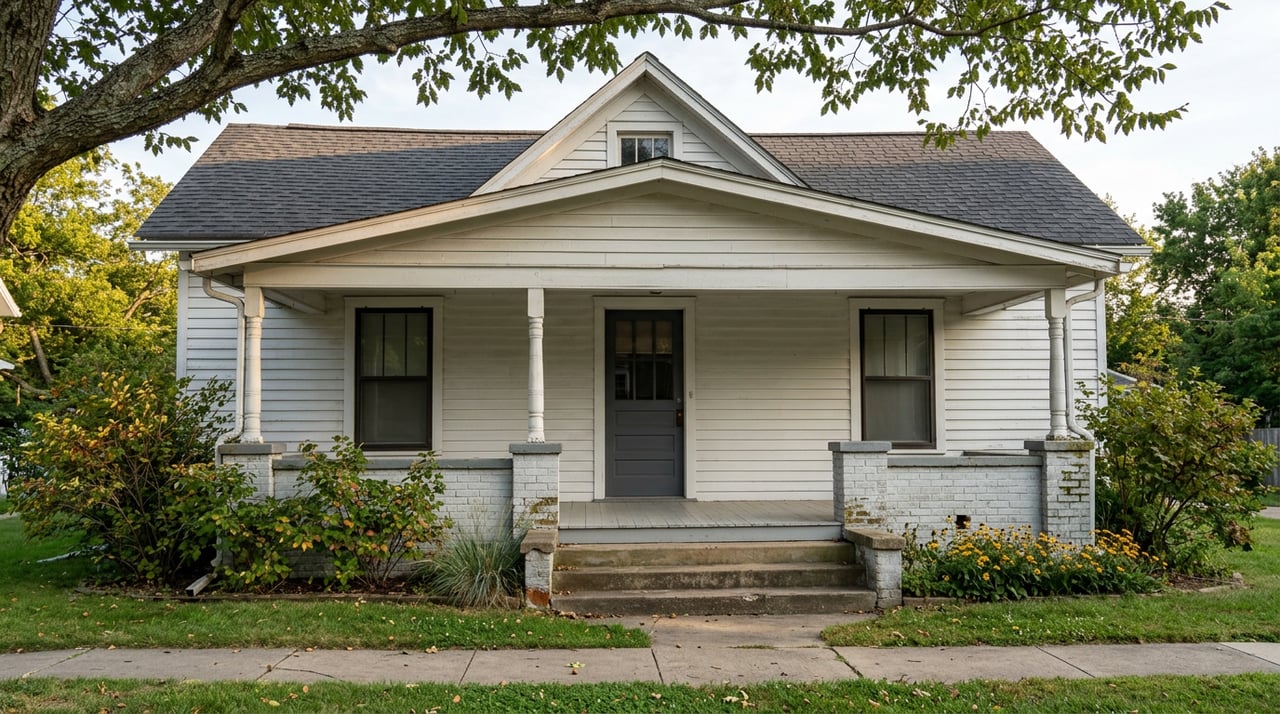
What Fills a Saturday on Casey, Iowa's Main Street
August 20, 2026
August 20, 2026
Casey had 387 people at the last census count. That number matters here, because it sits next to another one that shouldn't make sense: half a dozen or more antique dealers doing business within a few blocks of each other, a creamery serving strawberry rhubarb cobbler ice cream to a line of regulars, and a pub that has kept its lights on since before most of the people walking past it were born. Small Iowa towns lose their Main Streets all the time. Casey's has held, and the reason has less to do with luck than with how the businesses there actually work together.
A town this size usually supports a gas station, maybe a church or two, and not much else. Casey has that too, but its downtown carries more retail weight than the population would predict. Visit Adair County's own description of the place calls it an antique collector's paradise, pointing to the cobblestone streets and turn-of-the-century architecture that make the two-block stretch feel older and denser than its numbers suggest.
The reason the antique trade survives here when it disappears elsewhere is not that Casey has more collectors per capita. It's that a visitor who drives out for one shop ends up treating the whole street as a single stop. Nobody makes a special trip for just one dealer. They park once and walk the block, which means every storefront benefits from the foot traffic the others generate. That clustering effect is what keeps a downtown alive in a town this size, and it's a different economics than a strip mall, where each store has to draw its own customers.
The clearest anchor on that stretch is Casey Antique Country Mall at 104 W Logan Street, a multi-dealer space where the inventory turns over as fast as the shoppers do. It functions less like a single shop and more like a small indoor market, which is the model that seems to work in towns this size: one roof, many booths, one reason to park the car.
If you've lived here a while, you already know the rhythm. Saturday mornings bring people who drive in from Guthrie Center or Stuart specifically to work the antique row, and locals who happen to be walking past will duck in if something catches their eye through the window. The shop doesn't need every visitor to be a serious buyer. It needs enough people moving through the block that a percentage of them stop.
Between antique stops, the town's other draw is Casey Creamery, a small ice cream and coffee counter run by a mother and daughter. The flavors change with the season, but regulars keep coming back for combinations like strawberry rhubarb cobbler and Moose Tracks, made in-house rather than trucked in. The shop also carries gluten-free cones and non-dairy milk options, a small detail that matters if you're the parent trying to keep four kids and their allergies straight on a Saturday afternoon.
It occupies a repurposed building, which fits the pattern of the block around it. Nothing downtown was built to be what it is now. The antique malls sit in old commercial storefronts. The creamery took over a space that used to be something else entirely. That kind of reuse is part of why the street still has a pulse instead of a row of empty windows.
A few blocks over on McPherson Street, Pioneers Pub & Grub runs on a split schedule that says a lot about how the town actually eats. Lunch hours run most weekdays from late morning into early afternoon, then the doors close for a stretch before reopening midweek evenings for dinner. That's not a restaurant chasing every possible dining occasion. It's a business built around when people in a town this size are actually out and hungry, which for a lot of residents means lunch on a workday and one or two evenings a week when there's a reason to go out rather than eat at home.
If you've never noticed the gap in the afternoon, it's worth paying attention to next time you're planning a stop. Casey doesn't run on restaurant-industry hours. It runs on farm and small-business hours, and Pioneers keeps to that clock instead of fighting it.
Casey's Veterans Memorial Park was built by a local youth group, and the wall mural there depicting scenes from past wars was painted by Ray "Bubba" Sorensen. If that name sounds familiar, it should. Sorensen is the same artist behind The Freedom Rock, the boulder near Greenfield that he has repainted every year since 1999 to honor veterans, and the driving force behind a tour that placed a Freedom Rock in all 99 Iowa counties. He's also currently serving as an Iowa State Representative, splitting his winters between painting murals and legislative session in Des Moines.
Most people walking through the park probably know the mural is there without knowing who painted it or what else that person has done across the state. It's a small detail, but it's the kind of thing that changes how a familiar spot reads once you know it.
Part of why downtown Casey feels older than a lot of small Iowa towns is that so much of it actually is. According to Travel Iowa's page on historic downtown Casey, the Casey Fire Department has operated continuously since 1912, and Casey Mutual Telephone has been in business since 1898. St. John's Lutheran Church traces back to 1882, and Casey United Methodist Church to 1869, the same year the town itself was platted along the new rail line that gave it its name. The community got that name from the contracting firm of John and James Casey, who built the Chicago, Rock Island and Pacific line through the area, and most of the streets downtown still carry the names of Union Army generals from that era.
None of that is a museum piece. The buildings with those histories are still functioning as a fire station, a phone company, and two working churches. That continuity is part of what makes the two-block downtown feel solid instead of preserved for show.
A few minutes outside Casey sits Slayton's Rock, one of Iowa's largest fully exposed glacial deposits, weighing in at more than 500,000 pounds. It's not part of the downtown loop, but it's the kind of landmark that shows up in conversation once you've lived here long enough to have driven past it a hundred times without stopping. Worth a look the next time you have twenty minutes and nowhere to be.
None of these places would draw much attention on its own. A single antique mall in a bigger town is background noise. A creamery is nice but not remarkable. A pub with split hours is just a pub. What makes Casey's Main Street work is that all of it sits close enough together that one Saturday errand becomes three or four, and the businesses end up supporting each other without ever agreeing to.
That's worth knowing if you already call Casey home, and it's worth knowing if you're paying attention to what keeps a small Guthrie County town functioning while others nearby lose their downtown altogether. At Lake Panorama Realty, we spend a lot of time in towns like this one, and we like being able to point to specifics instead of generalities when people ask what makes a place tick. If you've got questions about Casey, Guthrie County, or anywhere else around Lake Panorama, Let's Get in Touch.
A trusted local team delivering professional service, strong market insight, and a seamless experience from search to closing.
CONNECT WITH US
LAKE PANORAMA REALTY
ADDRESS 5370 Chimra Rd Panora, IA 50216